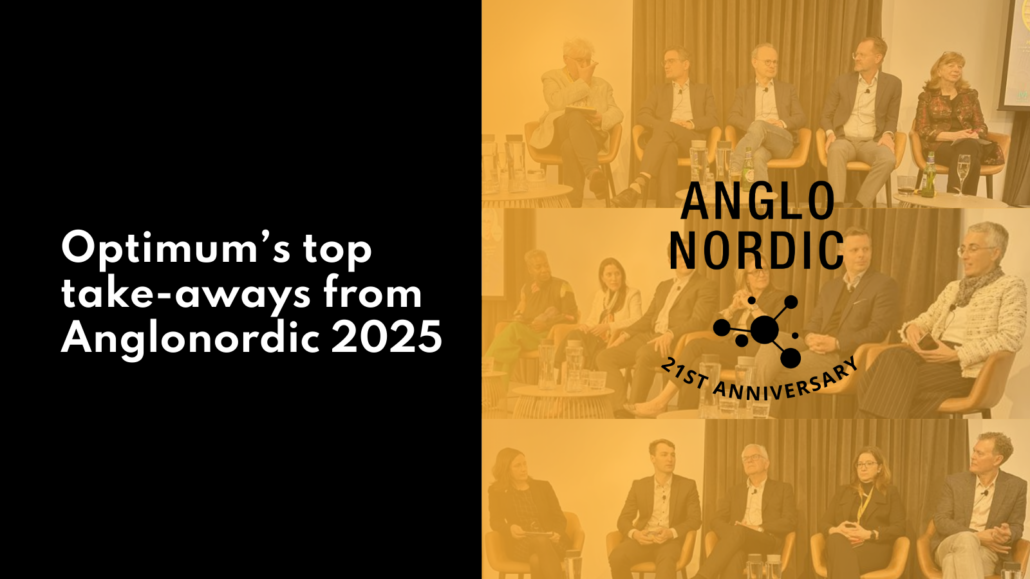
Optimum’s top take-aways from Anglonordic 2025
If a good rule of thumb for a conference is how full the hall is at the end of the day compared to the start, then the 21st Anglonordic Life Science Conference held last Thursday, attended by well over 300 people, was a resounding success.
Maybe it was still full because attendees were keen to hear the champagne-fuelled indiscretions from some of the biotech industry’s biggest hitters during the final panel of the day. Or maybe it was because they were waiting to do a bit of gossiping themselves over a glass of their own.
Things kicked off the night before with a sociable reception at the Institute of Healthcare Engineering, with delegates able to mix on the terrace thanks to the pleasant weather. As the sun set in the west, talk turned to the state of business – and inevitably to Trump’s pending tariff announcement.
Convening in the morning – after introductions by Optimum’s CEO Mary Clark, M Ventures’ Managing Director Hakan Goker, and conference founder Mattias Johansson, the CEO of Ezenze – biotech veteran Göran Ando, chairman of Nouscom, treated the audience to a rousing call-to-arms as to why the industry should feel “pride” in what it does.
“We don’t make widgets,” he said, “we provide important medicines for patients”.
“We do quite good things, don’t we? Sometimes I get a letter from a physician or a patient, that gives you the story of how – whatever medicine it is – has changed a life. And that letter keeps me going for months.”
While there were clear challenges, “this is, in the main, a resilient industry,” he said.
He’d lost count of the times accountancy firms “with their perfect maths” had predicted the demise of Pharma and Biotech, decrying their business model as impossible and saying they were bound to bite the dust.
Most medicines never made it to market and only two-thirds of those that did made a profit, their calculators reported. Ando countered: “But the other ones – they return a huge amount to investors, and that drives our business forward.”
Turning to today’s concerns, he said more had to be done to ensure new medicines were targeted at the right patients, said it was “foolish” not to recognise that payers had limited budgets, and urged execs to make the difficult decisions to kill struggling programmes sooner rather than later: “There’s always a temptation to keep it alive a little longer. That’s wasting money.”
Ando did not touch on tariffs. But he said job losses at key US agencies such as the FDA and NIH would have an impact, noting: “The vast majority of the payback from our investing comes from the US”.
With the composure of a man who has seen many seasons, he advised: “It’ll sort itself out, but in the meantime, you can expect some rough waters for a while.”
The second morning panel asked, “What’s new in immunity?” “Plenty,” is the short answer – it is truly a hot scientific area. One theme that emerged was the increasing “cross-fertilisation” of ideas, as panel chair Eleanor Malone, Editor-in-Chief, Commercial Insights at Citeline put it, between oncology and immunology. Of course this isn’t new: ever since the advent of checkpoint inhibitors, well over a decade ago, the two areas have been merging. But the panel noted that approaches and modalities more typically associated with one, were being applied more and more to the other.
Another theme the panel touched on repeatedly was the growing possibility of drugs (be they in vaccine or other form) that truly prevent cancer.
Nouscom CEO Marina Udier said it was working on an approach “to educate the immune system to active a defence against cancer that does not yet exist” – in other words, a heightened form of immune surveillance that snuffs out cancers before they can form tumours.
Similarly, Scancell CEO Phil L’Huillier said the company’s mission was nothing less than to develop potent immunotherapies for “a cancer-free future” – an objective that would have been scoffed at by most even a decade ago.
Its lead programme, a cancer vaccine being used in combination with two checkpoint inhibitors in metastatic melanoma, is seeing “a long term systemic immune response” in patients.
But he said they were looking to try it much earlier in treatment, in the neo-adjuvant setting, and what he found “really exciting” was the prospect of using it “beyond that … in the preventative setting, as a preventative cancer vaccine”.
With lunch beckoning, BioCentury’s Stephen Hansen managed to keep everyone in their seats by chairing a panel on Trends in Life Science Investing. He got the ball rolling with the sobering news that the XBI (index of biotech stocks) “has re-entered bear market territory”, although he conceded private markets were “not so bad”.
Erica Whittaker, VP and Head of Corporate Venture Fund at UCB Ventures, countered: “When people look back on this period they will see a golden age of scientific innovation, what with GLP-1s, the Covid vaccines and cell and gene therapies.”
Allan Marchington, Managing Director, Head of Life Sciences at ICG, said this was just one of several “reasons to be cheerful”, another (in the UK) being strong state support for the sector.
But the panel was realistic about the challenges too. Depressed valuations were the least of some biotechs’ problems, they noted, with Whittaker saying: “It’s not about valuation [at the moment]; it’s about whether they are getting the funds or not [to carry on]”.
Marchington chimed in: “It’s about staying alive, staying around until the next [funding] round.”
Hakan Goker, of M Ventures, admitted: “It’s a bit of a time when things are more anxious – but we are all optimists at heart.”
In terms of who is still landing deals, Lucy Edwardes Jones, Life Science Investor at BGF Investment Management, said: “There’s more money going to fewer companies.”
There had clearly been a shift towards companies with later-stage assets, as VCs and others looked to make a quicker return on their investments in today’s higher interest rate environment.
That meant there was less capital available for seed and Series A rounds and a concomitant move away from platform companies – which had been all the rage in the boom years.
Edwardes Jones said early-stage companies consequently needed a “laser sharp focus” on meeting milestones and perhaps had to concentrate more on their lead programme.
After lunch, journalist Lisa Urquhart chaired a panel on Women’s Health – both how it had advanced and what continued to hold it back.
Sebastian Bohl, Global Head of New Product Planning and Business Excellence at Merck Healthcare, KGaA said there had been “shift away” from thinking about women’s health purely in terms of reproductive health, while Sara Secall, General Partner at Inveready, said there was an increasing realisation that some common diseases (such as Alzheimer’s and lung cancer in non-smokers) were more prevalent in women than men.
But the panel noted that while women’s health was a bigger sector than it had been, it still tended to operate within fairly narrow confines.
There had been a whole slew of digital diagnostics aimed at women in recent years, said Ksenija Pavletic, Partner at Jelto Capital, with Freya Biosciences’ CEO Colleen Acosta recalling she was often asked: “Are you developing an app?” (Freya is not – it’s developing microbial immunotherapies for diseases of the female reproductive system.)
And Pavletic said women’s health was often aimed at just two stages of life: adolescence / young womanhood and post-menopause, even though in the intervening decades “there are an awful lot of extremely debilitating conditions” that women suffer from.
Urquhart raised the discrepancy in average amounts raised by “femtech” companies headed by male and female CEOs: $21.6m and $9.6m respectively, according to Pitchbook. Was this because men could tap into bigger, wealthier networks to raise funds? Was it because most investors were men and – as Urquhart put it – they tended to think: “Not my bits; not my problem?”
Paveltic suspected a wider problem: that people – both men and women – were simply not that well informed about conditions like endometriosis and PCOS: “It needs to be explained to the general public that these are not ‘lifestyle issues’.”
Casper Johansen VP and Head of External Innovation and Licensing at Ferring Pharmaceuticals, ended the panel on a positive note though, saying there were now more women involved in clinical trials, and regulators were more inclined to look at matters such as if a drug appeared to have a different effect in each of the sexes.
The final panel of the day chaired by Mike Ward of Clarivate, If I Knew Then What I Know Now, featured Joern-Peter Halle, Venture Partner and Advisor BGV, Leo Foundation CEO Peter Haahr, former BioNTech CBO and CCO Sean Marett, and Ruth McKernan CBE, Operating Partner at SV Health Investors.
After a little prompting, a modest Marett stole the show with tale after tale about how BioNTech pushed ahead with an IPO in 2019 despite shaky markets, before pivoting on a dime from being an oncology company to a vaccine maker as Covid swept the globe.
On the former, he said the words of one banker helped sway him to press on with the IPO despite the pain of having to take a 20% haircut on price.
“Just remember, an IPO is nothing more than a fundraise,” the taciturn banker told him. Sitting in a van in a Kansas City car park, Marett told his colleagues: “Let’s just take the cut and do it.”
But was that the whole story? Marett added: “And anyway, If I go back home without having done the deal, I don’t think I’ll have a wife!”
McKernan recalled how her budding career as a lab technician – she shunned university after getting good A-levels – was cut short by a boss who spotted the 18-year-old’s talent, drive and leadership qualities and told her: “Ruth, you’re wasted here.” When they crossed paths years later, at Pfizer in Sandwich, he added: “You were a nightmare to manage!”
She advised execs to face the many trials that would inevitably encounter during their careers – some of which they would fail – with resilience.
“Channel your Gareth Southgate,” she said.
This summary only gives a flavour of what was said during Anglonordic 21 – and doesn’t even touch on the six pitching sessions featuring scores of exciting companies, the relaxed networking during coffee, lunch and drinks, nor the official partnering meetings.
The date for the 22nd edition of Anglonordic has already been set – it’ll be held on Thursday April 23rd 2026. So, mark the date in your diaries now.


